What Event Caused the Prohibitoin of Figural Islamic Art
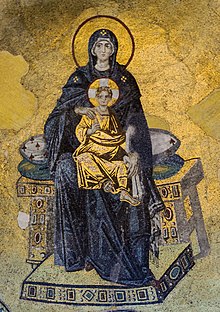
9th century Byzantine mosaic of the Hagia Sophia showing the prototype of the Virgin and Child, ane of the commencement post-iconoclastic mosaics. Information technology is fix confronting the original aureate background of the sixth century
Religious art is artistic imagery using religious inspiration and motifs and is often intended to uplift the mind to the spiritual. Sacred art involves the ritual and cultic practices and applied and operative aspects of the path of the spiritual realization inside the artist's religious tradition.
Buddhist art [edit]

Buddha statue in Sri Lanka.
Buddhist art originated on the Indian subcontinent post-obit the historical life of Siddhartha Gautama, sixth to fifth century BC, and thereafter evolved by contact with other cultures as it spread throughout Asia and the earth.
Buddhist art followed believers as the dharma spread, adapted, and evolved in each new host country. It developed to the n through Central Asia and into Eastern Asia to class the Northern branch of Buddhist art.
Buddhist art followed to the east as far as Southeast Asia to grade the Southern branch of Buddhist art.

An example of Tibetan Buddhist fine art: Thangka Depicting Vajrabhairava, c. 1740
In Republic of india, the Buddhist fine art flourished and fifty-fifty influenced the development of Hindu art, until Buddhism nearly disappeared in India around the tenth century due in part to the vigorous expansion of Islam aslope Hinduism.
Tibetan Buddhist fine art [edit]
Nigh Tibetan Buddhist artforms are related to the practice of Vajrayana or Buddhist tantra. Tibetan fine art includes thangkas and mandalas, ofttimes including depictions of Buddhas and bodhisattvas. Cosmos of Buddhist art is commonly washed every bit a meditation equally well as creating an object as help to meditation. An example of this is the cosmos of a sand mandala by monks; earlier and after the structure prayers are recited, and the grade of the mandala represents the pure environment (palace) of a Buddha on which is meditated to train the listen. The piece of work is rarely, if ever, signed by the artist. Other Tibetan Buddhist fine art includes metal ritual objects, such every bit the vajra and the phurba.
Indian Buddhist art [edit]
2 places suggest more vividly than whatever others the vitality of Buddhist cave painting from about the 5th century AD. I is Ajanta, a site in Republic of india long forgotten until discovered in 1817. The other is Dunhuang, one of the great oasis staging posts on the Silk Road...The paintings range from calm devotional images of the Buddha to lively and crowded scenes, often featuring the seductively full-breasted and narrow-waisted women more familiar in Indian sculpture than in painting.[1]
Christian art [edit]
Christian sacred art is produced in an attempt to illustrate, supplement and portray in tangible form the principles of Christianity, though other definitions are possible. Information technology is to brand imagery of the different beliefs in the earth and what it looks like. About Christian groups employ or accept used art to some extent, although some take had potent objections to some forms of religious image, and at that place take been major periods of iconoclasm inside Christianity.
Nigh Christian art is allusive, or built around themes familiar to the intended observer. Images of Jesus and narrative scenes from the Life of Christ are the well-nigh common subjects, especially the images of Christ on the Cross.
Scenes from the Old Testament play a part in the art of most Christian denominations. Images of the Virgin Mary, belongings the infant Jesus, and images of saints are much rarer in Protestant art than that of Roman Catholicism and Eastern Orthodoxy.
For the do good of the illiterate, an elaborate iconographic system developed to conclusively place scenes. For case, Saint Agnes depicted with a lamb, Saint Peter with keys, Saint Patrick with a shamrock. Each saint holds or is associated with attributes and symbols in sacred art.
History [edit]

Virgin and Child. Wall painting from the early on catacombs, Rome, 4th century.
Early Christian fine art survives from dates most the origins of Christianity. The oldest surviving Christian paintings are from the site at Megiddo, dated to around the year 70, and the oldest Christian sculptures are from sarcophagi, dating to the outset of the 2nd century. Until the adoption of Christianity by Constantine Christian art derived its style and much of its iconography from pop Roman art, but from this bespeak grand Christian buildings built under regal patronage brought a need for Christian versions of Roman elite and official art, of which mosaics in churches in Rome are the most prominent surviving examples.
During the development of early Christian art in the Byzantine empire (see Byzantine fine art), a more abstract aesthetic replaced the naturalism previously established in Hellenistic art. This new style was hieratic, pregnant its chief purpose was to convey religious meaning rather than accurately render objects and people. Realistic perspective, proportions, light and colour were ignored in favour of geometric simplification of forms, reverse perspective and standardized conventions to portray individuals and events. The controversy over the utilize of graven images, the interpretation of the Second Commandment, and the crisis of Byzantine Iconoclasm led to a standardization of religious imagery within the Eastern Orthodoxy.
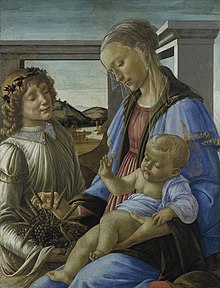
The Renaissance saw an increase in awe-inspiring secular works, merely until the Protestant Reformation Christian fine art continued to be produced in great quantities, both for churches and clergy and for the laity. During this time, Michelangelo Buonarroti painted the Sistine Chapel and carved the famous Pietà, Gianlorenzo Bernini created the massive columns in St. Peter'due south Basilica, and Leonardo da Vinci painted the Concluding Supper. The Reformation had a huge upshot on Christian art, apace bringing the production of public Christian art to a virtual halt in Protestant countries, and causing the destruction of most of the art that already existed.
Equally a secular, non-sectarian, universal notion of art arose in 19th-century Western Europe, secular artists occasionally treated Christian themes (Bouguereau, Manet). Merely rarely was a Christian creative person included in the historical canon (such as Rouault or Stanley Spencer). However many modern artists such equally Eric Gill, Marc Chagall, Henri Matisse, Jacob Epstein, Elisabeth Frink and Graham Sutherland have produced well-known works of fine art for churches.[two] Through a social interpretation of Christianity, Fritz von Uhde also revived the interest in sacred art, through the depiction of Jesus in ordinary places in life.
Since the advent of printing, the auction of reproductions of pious works has been a major element of pop Christian civilization. In the 19th century, this included genre painters such as Mihály Munkácsy. The invention of color lithography led to broad apportionment of holy cards. In the modern era, companies specializing in modern commercial Christian artists such as Thomas Blackshear and Thomas Kinkade, although widely regarded in the fine art globe as kitsch,[3] have been very successful.
The concluding part of the 20th and the first part of the 21st century have seen a focused attempt by artists who merits faith in Christ to re-establish art with themes that circumduct around faith, Christ, God, the Church, the Bible and other classic Christian themes as worthy of respect past the secular fine art world. Artists such equally Makoto Fujimura take had significant influence both in sacred and secular arts. Other notable artists include Larry D. Alexander, Gary P. Bergel, Carlos Cazares, Bruce Herman, Deborah Sokolove, and John August Swanson.[4]
Confucian fine art [edit]
Confucian art is art inspired by the writings of Confucius, and Confucian teachings. Confucian art originated in People's republic of china, and so spread westwards on the Silk road, southward down to southern China and then onto Southeast Asia, and eastwards through northern People's republic of china on to Japan and Korea. While it nonetheless maintains a strong influence within Republic of indonesia, Confucian influence on western art has been limited. While Confucian themes enjoyed representation in Chinese art centers, they are fewer in comparison to the number of artworks that are about or influenced by Daoism and Buddhism.[five]
Hindu art [edit]
Hinduism, with its 1 billion followers, it makes upwardly about 15% of the world's population and as such the civilization that ensues information technology is full of unlike aspects of life that are effected by art. There are 64 traditional arts that are followed that kickoff with the classics of music and range all the manner to the application and adornment of jewellery. Since religion and culture are inseparable with Hinduism recurring symbols such as the gods and their reincarnations, the lotus blossom, extra limbs, and even the traditional arts brand their appearances in many sculptures, paintings, music, and dance.
Islamic fine art [edit]

A specimen of Islamic sacred art: in the Swell Mosque of Kairouan in Tunisia, the upper part of the mihrab (prayer niche) is decorated with ninth-century lusterware tiles and painted intertwined vegetal motifs.
A prohibition against depicting representational images in religious art, equally well every bit the naturally decorative nature of Arabic script, led to the use of calligraphic decorations, which unremarkably involved repeating geometrical patterns and vegetal forms (arabesques) that expressed ideals of order and nature. These were used on religious architecture, carpets, and handwritten documents.[6] Islamic art has reflected this counterbalanced, harmonious world-view. It focuses on spiritual essence rather than physical class.
While there has been an aversion to potential idol worship through Islamic history, this is a distinctly modernistic Sunni view. Farsi miniatures, along with medieval depictions of Muhammad and angels in Islam, stand as prominent examples contrary to the modern Sunni tradition. Also, Shi'a Muslims are much less balky to the delineation of figures, including the Prophet's as long as the delineation is respectful.
Figure representation [edit]
The Islamic resistance to the representation of living beings ultimately stems from the belief that the cosmos of living forms is unique to God. Information technology is for this reason that the part of images and epitome makers has been controversial.
The strongest statements on the field of study of figural depiction are made in the Hadith (Traditions of the Prophet), where painters are challenged to "breathe life" into their creations and threatened with punishment on the Twenty-four hour period of Judgment.
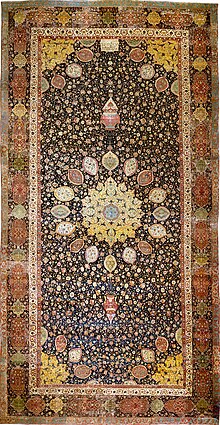
The Qur'an is less specific but condemns idolatry and uses the Arabic term musawwir ("maker of forms", or artist) as an epithet for God. Partially as a issue of this religious sentiment, figures in painting were often stylized and, in some cases, the devastation of figurative artworks occurred. Iconoclasm was previously known in the Byzantine menstruum and aniconicism was a characteristic of the Judaic world, thus placing the Islamic objection to figurative representations within a larger context. As ornament, however, figures were largely devoid of any larger significance and perhaps therefore posed less challenge.[vii] As with other forms of Islamic decoration, artists freely adapted and stylized basic homo and beast forms, giving rise to a nifty variety of figural-based designs.
Arabesque [edit]
![[icon]](https://upload.wikimedia.org/wikipedia/commons/thumb/1/1c/Wiki_letter_w_cropped.svg/20px-Wiki_letter_w_cropped.svg.png) | This department is empty. You lot tin can help by adding to it. (Oct 2018) |
Calligraphy [edit]
Calligraphy is a highly regarded element of Islamic art. The Qur'an was transmitted in Arabic, and inherent within the Arabic script is the potential for ornamental forms. The employment of calligraphy as decoration had a definite aesthetic appeal just often also included an underlying talismanic component. While most works of art had legible inscriptions, non all Muslims would have been able to read them. One should always keep in listen, however, that calligraphy is principally a means to transmit a text, admitting in a decorative form.[viii] From its simple and primitive early examples of the 5th and sixth century Advertisement, the Standard arabic alphabet adult chop-chop after the ascension of Islam in the 7th century into a beautiful form of art. The chief 2 families of calligraphic styles were the dry out styles, called generally the Kufic, and the soft cursive styles, which include Naskhi, Thuluth, Nastaliq and many others.[nine]
Geometry [edit]
Geometric patterns make up one of the three nonfigural types of decoration in Islamic art. Whether isolated or used in combination with nonfigural ornamentation or figural representation, geometric patterns are popularly associated with Islamic art, largely due to their aniconic quality. These abstract designs non only adorn the surfaces of monumental Islamic architecture but likewise function as the major decorative element on a vast assortment of objects of all types.[10]
Jain art [edit]
Jain art refers to religious works of art associated with Jainism. Fifty-fifty though Jainism spread merely in some parts of India, it has made a meaning contribution to Indian art and compages.[11]
Mandaean art [edit]
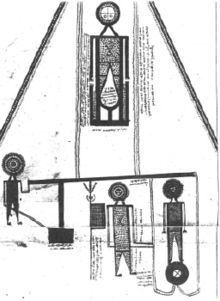
Mandaean art can be plant in illustrated manuscript scrolls called diwan. Mandaean roll illustrations, commonly labeled with lengthy written explanations, typically incorporate abstract geometric drawings of uthras that are reminiscent of cubism or prehistoric rock fine art.[12]
Sikh art [edit]
The art, culture, identity and societies of the Sikhs has been merged with different locality and ethnicity of different Sikhs into categories such as 'Agrahari Sikhs', 'Dakhni Sikhs' and 'Assamese Sikhs'; yet in that location has emerged a niche cultural phenomenon that tin can exist described every bit 'Political Sikh'. The art of diaspora Sikhs such every bit Amarjeet Kaur Nandhra,[13] and Amrit and Rabindra Kaur Singh (The Singh Twins),[14] is partly informed by their Sikh spirituality and influence.
Taoist art [edit]
Taoist art (likewise spelled as Daoist art) relates to the Taoist philosophy and narratives of Lao-tzu (too spelled as Laozi) that promote "living simply and honestly and in harmony with nature."[fifteen]
Run into too [edit]
- Religious image
- Spiritualist art
References [edit]
- ^ "History Of Buddhism". Historyworld.internet. Retrieved 2013-09-06 .
- ^ Beth Williamson, Christian Fine art: A Very Short Introduction, Oxford University Press (2004), folio 110.
- ^ Cynthia A. Freeland, But Is It Art?: An Introduction to Art Theory, Oxford University Press (2001), page 95
- ^ Buenconsejo, Clara (21 May 2015). "Gimmicky Religious Art". Mozaico. Archived from the original on 29 September 2015. Retrieved 2 June 2015.
- ^ Karetzky, Patricia (2014). Chinese Religious Art. Lanham, Dr.: Lexington Books. p. 127. ISBN9780739180587.
- ^ "Islamic Art – Islamic Art of Calligraphy and Arabesque". Archived from the original on 2004-02-18. Retrieved 2014-02-11 .
- ^ "Figural Representation in Islamic Art | Thematic Essay | Heilbrunn Timeline of Art History". Metropolitan Museum of Fine art. Retrieved 2013-09-06 .
- ^ "Calligraphy in Islamic Art | Thematic Essay | Heilbrunn Timeline of Fine art History". Metropolitan Museum of Art. Retrieved 2013-09-06 .
- ^ "Art of Standard arabic Calligraphy". Sakkal. Retrieved 2013-09-06 .
- ^ "Geometric Patterns in Islamic Fine art | Thematic Essay | Heilbrunn Timeline of Art History | The Metropolitan Museum of Art". Metmuseum.org. Retrieved 2013-09-06 .
- ^ Kumar 2001, p. one. sfn fault: no target: CITEREFKumar2001 (assistance)
- ^ Nasoraia, Brikha H.S. (2021). The Mandaean gnostic religion: worship do and deep thought. New Delhi: Sterling. ISBN978-81-950824-1-4. OCLC 1272858968.
- ^ Textile artist Amarjeet Kaur Nandhra
- ^ Singh Twins Art Launches Liverpool Fest
- ^ Augustin, Birgitta. "Daoism and Daoist Art." In Heilbrunn Timeline of Art History. New York: The Metropolitan Museum of Art, 2000–. http://www.metmuseum.org/toah/hd/daoi/hd_daoi.htm (December 2011)
Further reading [edit]
- Evans, Helen C.; Wixom, William D. (1997). The glory of Byzantium: art and culture of the Middle Byzantine era, A.D. 843–1261 . New York: The Metropolitan Museum of Fine art. ISBN978-0-8109-6507-2.
- Hein, David. "Christianity and the Arts." The Living Church building, May 4, 2014, 8–xi.
- The Vatican: spirit and fine art of Christian Rome . New York: The Metropolitan Museum of Art. 1982. ISBN978-0-87099-348-0.
- Morgan, David (1998). Visual Piety: A History and Theory of Pop Religious Images. Berkeley, CA: University of California Press.
- Sauchelli, Andrea (2016). The Volition to Brand‐Believe: Religious Fictionalism, Religious Behavior, and the Value of Fine art. Philosophy and Phenomenological Enquiry, 93, iii.
- Charlene Spretnak, The Spiritual Dynamic in Modern Art : Art History Reconsidered, 1800 to the Present.
- Veith, Gene Edward, inferior. The Gift of Art: the Place of the Arts in Scripture. Downers Grove, Ill.: Inter-Varsity Press, 1983. 130 p. ISBN 978-0-87784-813-4
External links [edit]
melansonwrintrah61.blogspot.com
Source: https://en.wikipedia.org/wiki/Religious_art
0 Response to "What Event Caused the Prohibitoin of Figural Islamic Art"
Post a Comment